



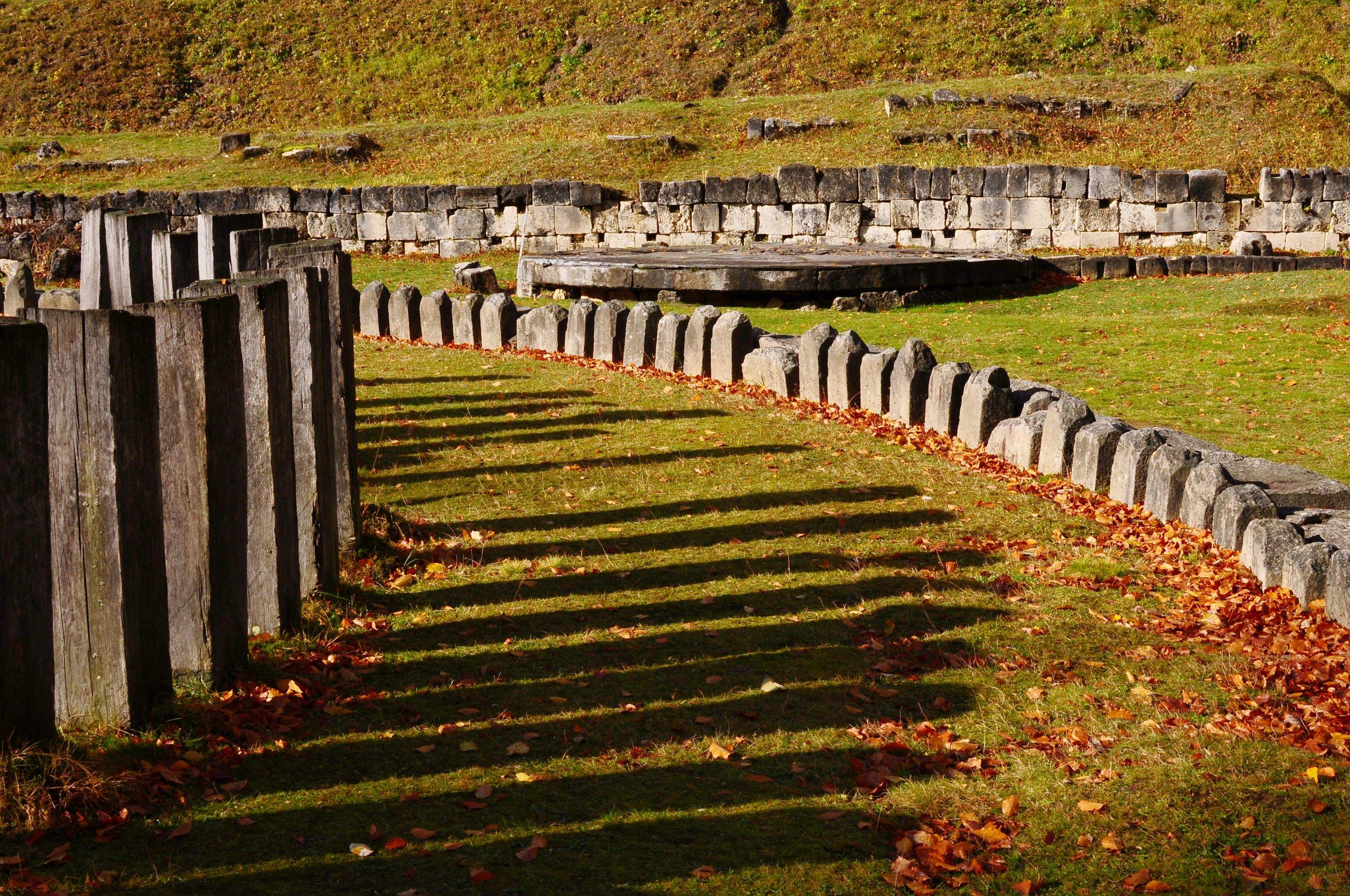





What does a living museum mean, the key element in the title of our project? How do we propose to give life to the Capital of Dacia?
We work together with people: residents of Hunedoara county, Romanian and foreign visitors, pupils and students, cultural entrepreneurs, the scientific and academic community. This actually means that the project promoter, the Romanian partner and the Norwegian partner involve the target groups in the revitalization activities.
How does the vast range of our revitalization activities look like:
- 1. Come to Lapidarium.
We build charming exhibition pavilions. - Work as a craftman
We organize two craft fairs with practical demonstrations and a lot of authenticity. - 3. Become one of the protectors of heritage.
Through a special program, we shape a respectful generations towards their heritage. - Little archaeologists in action.
We're opening the doors to summer schools for children with teaching archaeology in mind. - 5. We are spreading information about the project.
We make sure that everyone will see the project through promotions. - 6. We are modeling.
The construction phases of the wall are translated into a captivating miniature model. - 7. We are placing the creative INFO-EDU totems.
- 8. Listen to the story.
Find out fascinating details about the fortification wall with the help of the bilingual audio guide. - 9. Discover the Info-Edu-Cult Kit
An information and cultural education program for children and young people. - 10. Introducing the project.
We are developing a design kit, maps, handouts, infographics, banners and roll-ups all about the project. - 11. We are visible.
Through billboards and an information plaque with details on the project. - Step into a new reality.
We're developing an intelligent IT application that will tell the history of the monument. - 14. Forge the iron.
We're waiting for you at the Dacian blacksmith's workshop.
"Capital of Dacia - A Living Museum of the European Cultural Heritage" is the name of the project submitted by Hunedoara County Council and organised in partnership with Mihai Eminescu Trust and Møre & Romsdal County Council from Norway. The project for the restoration and revitalization of the Sarmizegetusa Regia archaeological site is financed with the support EEA Grants 2014 - 2021 within the RO-Culture Programme.
EEA and Norway Grants
RO-Culture Programme
EEA & Norwegian Grants
Ministry of Culture
Project Management Unit - UMP
National Heritage Institute -
Hunedoara County Council
Mihai Eminescu Trust
Møre og Romsdal fylkeskommune